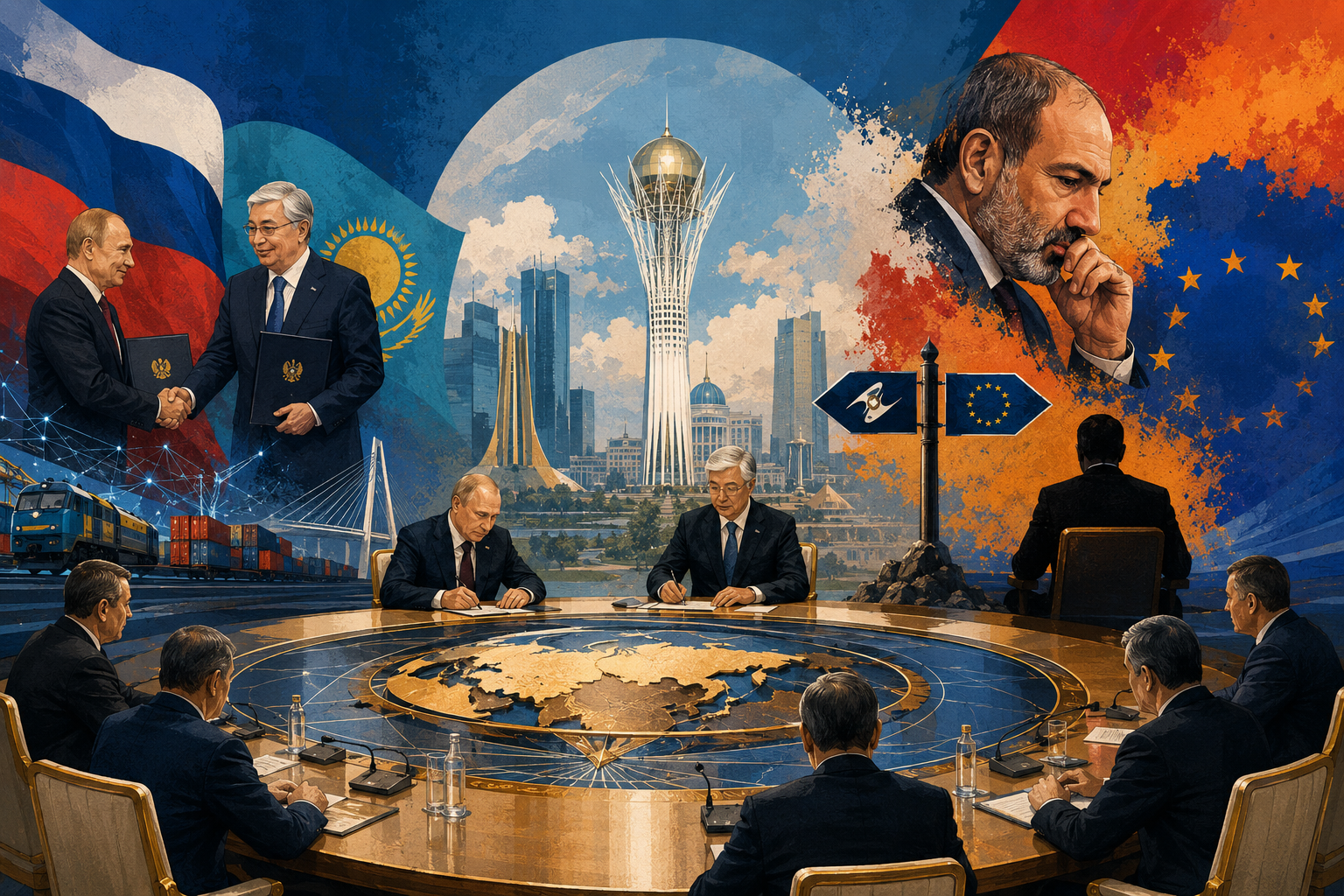
The Supreme Eurasian Economic Council convened in Astana today, 29 May, with Armenian Deputy Prime Minister Mher Grigoryan attending in place of Prime Minister Nikol Pashinyan, who declined the invitation citing the proximity of the 7 June parliamentary elections. The formal agenda includes, for the first time in the EAEU's twelve-year history, a discussion of a member state's European Union integration aspirations and potential withdrawal from the bloc.
Yesterday, 28 May, Russian President Putin and Kazakh President Tokayev signed a package of 16 documents during their bilateral summit, including a joint statement on the “seven foundations of friendship between the peoples of Russia and Kazakhstan.” The document package also covered digital cooperation, trade facilitation and infrastructure. Putin addressed the plenary session of the 5th Eurasian Economic Forum, where the central theme was artificial intelligence and digitalization within the EAEU.
“We do not want Armenia to leave the EAEU; we want Armenia to continue to prosper, but we see the problems that will arise in the event of accession to or closer ties with the EU. In principle, they are already emerging.”
— Russian Deputy Prime Minister Alexei Overchuk, TASS, May 2026
What is actually being discussed — and what is not
The Armenia item is being held in closed session, which limits real-time reporting. What is known from pre-summit statements: Moscow's position is that simultaneous EAEU membership and EU accession is impossible, and that Armenia must eventually choose. Russia's Deputy Prime Minister Overchuk framed this as economic concern rather than political pressure, pointing to Armenia's trade figures — EAEU countries accounted for 38.5% of Armenian exports last year — and noting that Armenia's trade with the EAEU fell 15.6% in the first quarter of 2026, while its trade with the EU rose.
Pashinyan's position, stated repeatedly, is that Armenia intends to maintain EAEU membership for as long as legally and economically feasible while pursuing EU standards and eventual accession. The EU Integration Act adopted last year does not set a withdrawal date. What it does do is create an institutional trajectory that makes EAEU membership progressively harder to sustain: as Armenian regulations converge with EU standards, divergence from EAEU technical norms will grow.
Figures that frame the discussion
· Armenia’s trade with EAEU countries fell 15.6% in Q1 2026 year-on-year
· Armenia’s trade with the EU reached $763.2 million in Q1 2026
· EAEU countries (primarily Russia) still account for 38.5% of Armenian exports
· Pashinyan absent: Deputy PM Grigoryan represents Armenia at closed session
· Putin and Tokayev signed 16 documents on 28 May, including seven-foundations joint statement
The Kazakhstan angle
For Astana, hosting a summit that formally discusses one member's exit is diplomatically delicate. Kazakhstan has its own interest in demonstrating that the EAEU is a genuinely voluntary arrangement — this matters for its Western partnerships and for its domestic political narrative of an independent multi-vector foreign policy. At the same time, a precedent for EAEU exit without serious economic consequence would be a signal Astana prefers not to amplify. CAW will report on summit outcomes as they emerge.