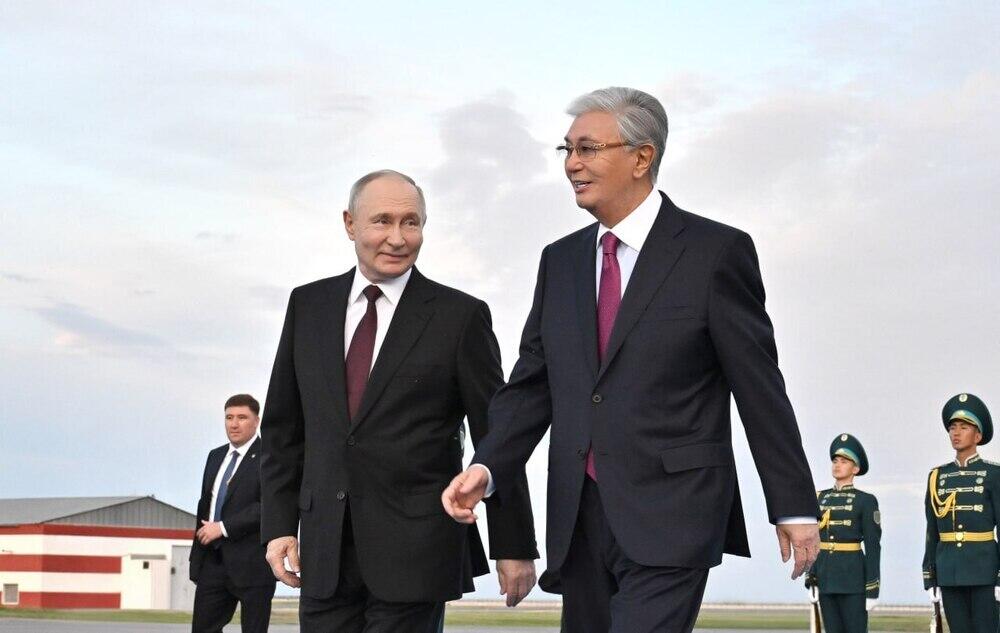
Vladimir Putin concluded his two-day state visit to Kazakhstan on 29–30 May with remarks at the Eurasian Economic Forum that went significantly beyond the forum’s stated agenda of artificial intelligence and digital development. Speaking in Astana, Putin warned that “the Russian Federation has all the means to raze to the ground anyone who tries” to threaten Russian air defence installations, referring to NATO statements about the Kaliningrad region. He also said the battlefield situation in Ukraine was developing “in such a way that Russia can talk about the imminent end of the conflict.”
The choice of venue for these remarks was not incidental. Delivering maximalist language on Ukraine from Astana — the capital of a country that has refused to recognise Russia’s actions in Ukraine and has maintained relations with Kyiv — creates a specific kind of pressure. Tokayev, who was present, did not publicly respond to the Ukraine statements. The 16 bilateral documents signed on 28 May, including the “seven foundations of friendship,” provide cover: the relationship is publicly affirmed even as its limits are privately understood.
“Everyone has stated that we don’t want Armenia to leave our Eurasian Union. At the same time, we respect Armenia’s choice. We propose holding elections there on this issue.”
— Belarusian President Alexander Lukashenko, EAEU summit, 29 May 2026
Lukashenko and the referendum proposal
Among the more striking EAEU summit interventions was Lukashenko’s suggestion that Armenia hold a referendum on EAEU membership. The proposal is constitutionally irrelevant — EAEU membership is a government decision, not a plebiscite matter under Armenian law — but politically pointed: it frames the June 7 parliamentary elections as a de facto referendum on the question, which is precisely the framing that Pashinyan’s opponents in Yerevan have been pushing. Coming eight days before the vote, and from the EAEU’s most vocal member, it is not a neutral observation.
For Astana, the visit produced what it needed: visible high-level engagement, a package of signed documents, and a demonstration of bilateral significance. What it did not produce is any publicly visible Kazakh endorsement of Putin’s Ukraine positions or his EAEU pressure on Armenia. The silence on both is itself a form of communication.