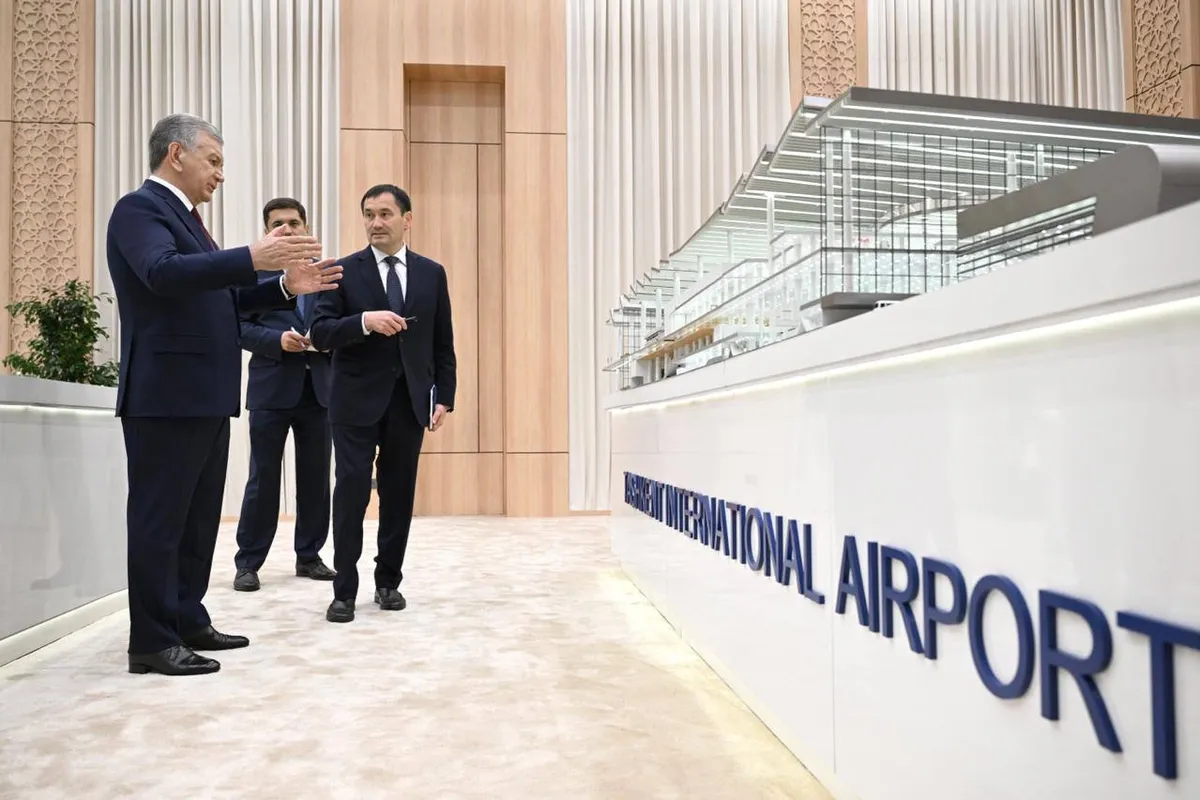
Uzbek President Shavkat Mirziyoyev has officially inaugurated construction of the new Tashkent International Airport, a $4.5 billion project that, upon completion, will be Central Asia's largest aviation facility. The project is being developed under a public-private partnership by an international consortium: Vision Invest of Saudi Arabia holds a 45% stake, Japan's Sojitz Corporation 30%, South Korea's Incheon International Airport Corporation 15%, and Uzbekistan Airports 10%.
The new airport will be built on a 1,300-hectare site in the Tashkent region, in the Urta Chirchik and Kuyichirchik districts. The first construction phase, costing $2.5 billion, will deliver a 208,400-square-metre passenger terminal capable of handling 20 million passengers and 129,000 tonnes of cargo annually, with two four-kilometre runways and 169 aircraft parking stands. The existing Tashkent Islam Karimov International Airport, which handles approximately 9 million passengers per year and cannot be expanded due to its urban location, will be closed when the new facility opens.
“Our goal is to turn Uzbekistan into a major aviation hub connecting East and West, North and South.”
— President Shavkat Mirziyoyev, inauguration ceremony
Why this project matters beyond aviation
The airport project is a signal of the confidence that Gulf, Japanese and Korean capital is placing in Uzbekistan's reform trajectory. The consortium structure is itself a geopolitical statement: Saudi Arabia as the lead investor, with Japanese and Korean technical partners, and no Chinese participation — a deliberate diversification of Uzbekistan's infrastructure financing that mirrors Tashkent's broader strategy of balancing BRI-linked Chinese investment with capital from other partners.
The facility is planned as part of a broader multimodal hub. It will connect to toll highways linking Tashkent with Samarkand, Andijan and Bostanlyk, and will feature a dedicated high-speed rail station and shuttle service to the planned New Tashkent city development. Officials project revenues of more than $27 billion and tens of thousands of jobs across construction, tourism and logistics over the project's lifetime.
Passenger traffic in Tashkent has tripled over eight years to 9 million per year. By 2040 it is projected to reach 24 million. The current airport, constrained by its location inside the city, cannot accommodate that growth. The new facility is being built in four phases; the PPP agreement sets out the terms under which the private consortium will recover its investment through airport revenues over a multi-decade concession.