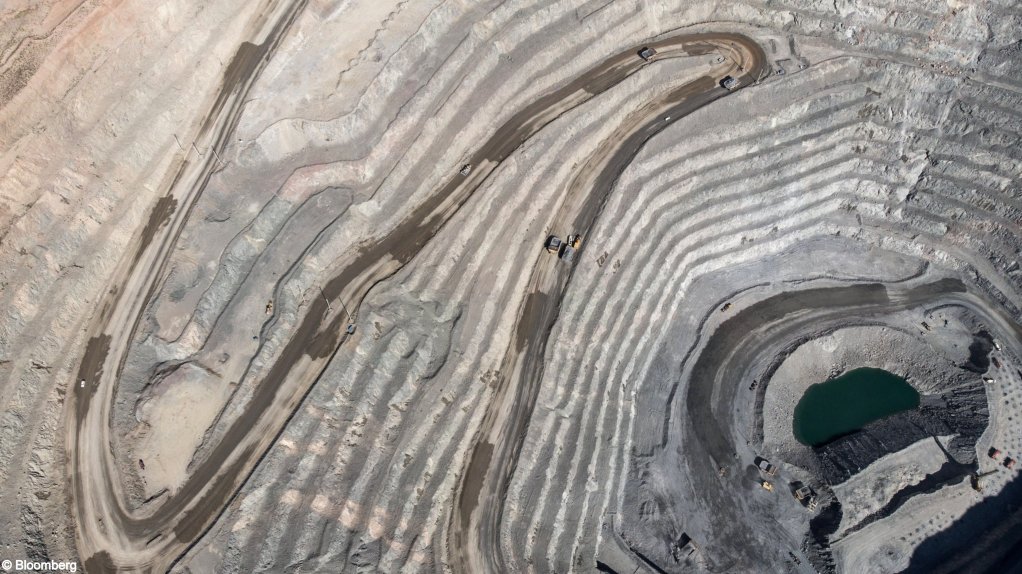
345,000 t copper produced by OT in 2025 — up 61% year-on-year
500,000 t projected annual average output 2028–2036: 4th largest mine in the world
$18 bn total investment in the OT project (open pit + underground)
34% / 66% Mongolia’s stake (Erdenes Mongol) vs Rio Tinto’s ownership
$450 mn tax dispute: Mongolia’s claim against Rio Tinto in court
~60% revenue share Mongolia is demanding in renegotiation (vs current 34%)
until 2041 estimated year Mongolia would receive dividends under current loan terms
There is a number that explains everything about Mongolia’s frustration with Oyu Tolgoi: 2041. Under the current financial structure, the Mongolian government — which holds a 34% stake in one of the world’s largest copper deposits — is not expected to receive dividends until it has repaid the multi-billion-dollar loan that Rio Tinto extended to finance Mongolia’s share of development costs. At current repayment trajectories, that is 2041. Meanwhile, copper is at near-record prices, the underground mine is producing at full tilt, and Rio Tinto is reporting a 61% surge in OT copper output.
In March 2026, the Mongolian government moved formally to reopen negotiations, demanding accelerated dividend payments and a revenue share of roughly 60% — nearly double its current 34% ownership stake. The government has also filed suit in court over alleged tax underpayments of $450 million tied to Rio Tinto’s depreciation accounting for the 2021 and 2022 tax years. Parliamentary hearings that began in December 2025 produced a unanimous Khural resolution mandating changes to protect national interests. Rio Tinto responded in the only way it could while keeping negotiations alive: “These discussions reflect our continued commitment to working together to achieve Oyu Tolgoi’s full potential for the benefit of all partners.”
How the original deal went wrong
The Oyu Tolgoi project was signed at a moment of Mongolian financial vulnerability. The 2009 Investment Agreement came shortly after the 2008 global financial crisis had hammered commodity prices and left Ulaanbaatar with limited leverage to negotiate. The terms that resulted — a 34% government stake, financed by a Rio-extended loan at an 11.1% effective interest rate, well above market — looked manageable in a feasibility model. They became structurally punishing as the underground mine’s construction costs ballooned far above initial estimates, adding to the debt Mongolia must repay before dividends flow.
The underground mine alone cost more than $7 billion to develop, against original estimates considerably lower. Rio Tinto absorbed significant overruns and, in January 2022, waived $2.4 billion of Mongolian debt in what it described as a partnership reset — clearing the way for underground production to begin. That concession bought goodwill and resumed construction. It did not resolve the underlying imbalance: Mongolia holds a stake in the project but has had no meaningful control over costs, and the dividend clock is still running toward 2041.
“These early agreements often lock in terms that look reasonable at the feasibility stage but become increasingly unbalanced as the project scales up.”
— Analyst comment, EU Reporter, February 2026
Why the moment is now
Three things have converged in 2026 to give Mongolia its best negotiating position since the project began. The first is production. OT delivered 345,000 tonnes of copper concentrate in 2025, up 61% year-on-year as the underground ramp-up completed. Q1 2026 output rose a further 9% year-on-year. By 2028–2036, the mine is projected to average 500,000 tonnes annually — enough to make it the fourth-largest copper producer in the world and account for roughly 30% of Rio Tinto’s global copper output.
The second is price. Copper is trading at $5.64 per pound as of the latest market data — near historic highs, driven by EV demand, grid infrastructure buildout and structural supply deficits. At these prices, the gap between what OT generates and what Mongolia receives is visible and politically toxic.
The third is Rio Tinto’s exposure. Oyu Tolgoi is not a marginal asset for the company — it is the cornerstone of its stated target to achieve 3% compound annual growth in copper-equivalent output through 2030. A prolonged dispute, operational disruption or government-forced revision to the investment framework would directly threaten that trajectory. Rio Tinto has more to lose from a breakdown than from a renegotiation.
The Kumtor precedent — and its limits
Mongolia’s parliament and government are operating with full awareness of the regional precedents. The Kumtor gold mine in Kyrgyzstan, nationalised by the Kyrgyz government in 2021 after years of disputes with Canadian operator Centerra Gold, has generated $3.45 billion in revenue since nationalisation, with $891.6 million flowing to the state budget. For Mongolian politicians facing domestic pressure to extract more value from the country’s main asset, Kumtor is the argument: a smaller, poorer neighbour did it, and the numbers worked out.
The counter-argument is also visible. Kyrgyzstan’s nationalisation spooked foreign investors and is regularly cited by mining companies as a risk factor when evaluating Central Asian projects. Mongolia’s investment climate — already regarded as volatile in the mining industry — would take a serious hit from a forced expropriation, particularly given that OT is the only large-scale project that has attracted sustained major international investment. The parliamentary hearings and legal proceedings are a form of structured pressure: sufficient to extract concessions, not (yet) a prelude to nationalisation.
What this means beyond Mongolia
The OT dispute is one of the clearest illustrations of a tension that runs through the entire global critical minerals landscape in 2026. Resource-rich developing countries — from Mongolia to Zambia to Chile — signed agreements when they needed capital and lacked alternatives. Now, with copper, lithium, cobalt and rare earths at the centre of the global energy transition, those countries have leverage they did not have when the deals were signed. Western governments and mining companies courting new agreements are having to offer terms that would have been unimaginable a decade ago.
For the United States and the European Union, which are actively building alternative critical mineral supply chains to reduce dependence on China, Mongolia is a significant case. OT copper is not going to China — the processed concentrate is exported primarily to markets that include European and North American buyers. A negotiated settlement that keeps the mine operating smoothly and improves Mongolia’s revenue share is a better outcome for Western supply chain interests than a drawn-out dispute that creates operational uncertainty or pushes Ulaanbaatar toward Beijing-aligned alternatives.
The renegotiation is ongoing. Rio Tinto’s Q1 2026 results maintained full-year copper guidance of 800,000–870,000 tonnes, signalling that the dispute has not yet affected operations. Whether it stays that way depends on how far both sides are willing to move.