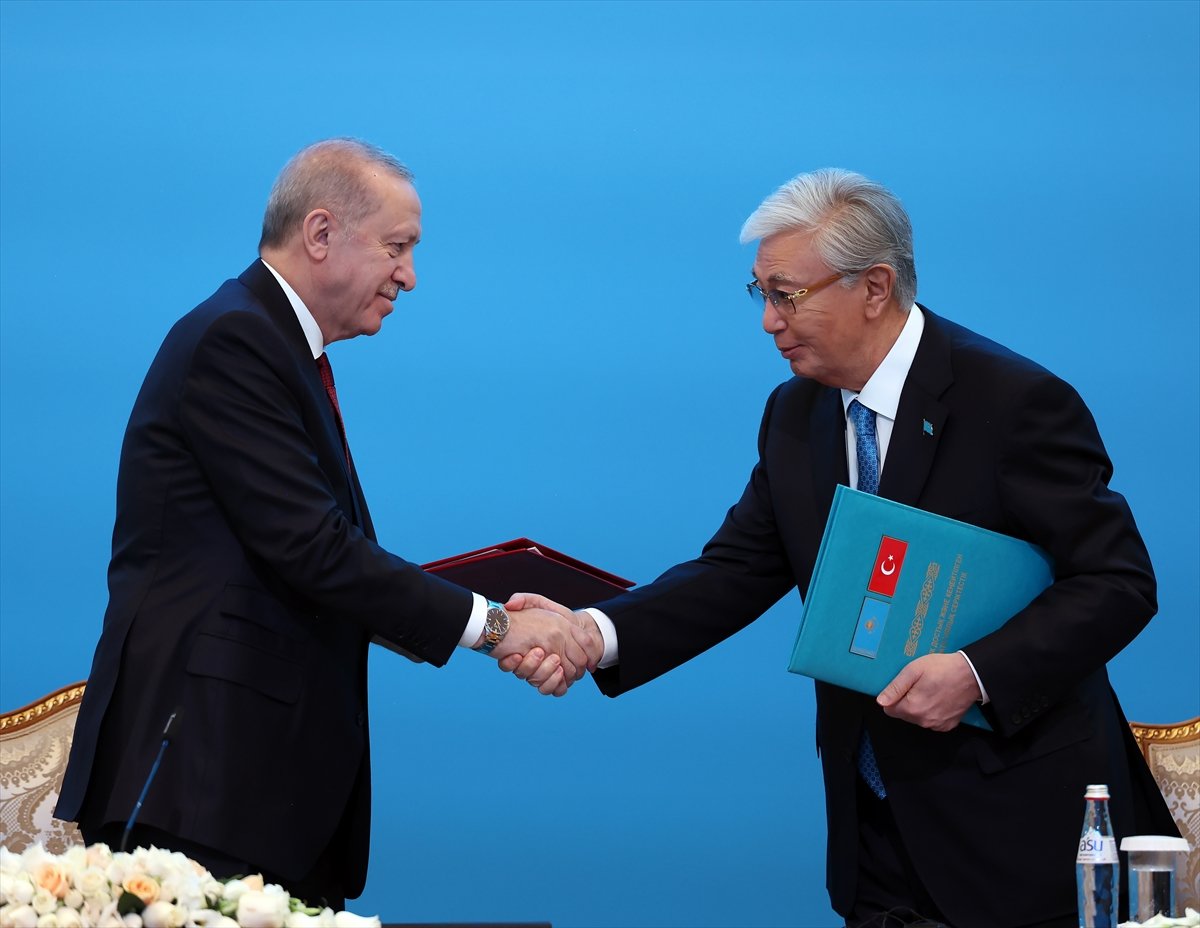
When Turkish President Recep Tayyip Erdoğan's aircraft entered Kazakhstan's airspace on Wednesday, it was escorted by fighter jets. At the Nursultan Nazarbayev International Airport, two helicopters flew overhead carrying the flags of both countries. Children greeted him with the words "Welcome to the ancestral homeland." Erdoğan replied: "We are glad to be here."
The theatre of the visit was deliberate and significant. Astana was hosting not only a bilateral state visit — the sixth meeting of the Türkiye-Kazakhstan High-Level Strategic Cooperation Council — but also the Business Forum of the Organisation of Turkic States and, the following day, an informal OTS summit in Turkistan. For one week, Kazakhstan became the diplomatic centre of the Turkic world.
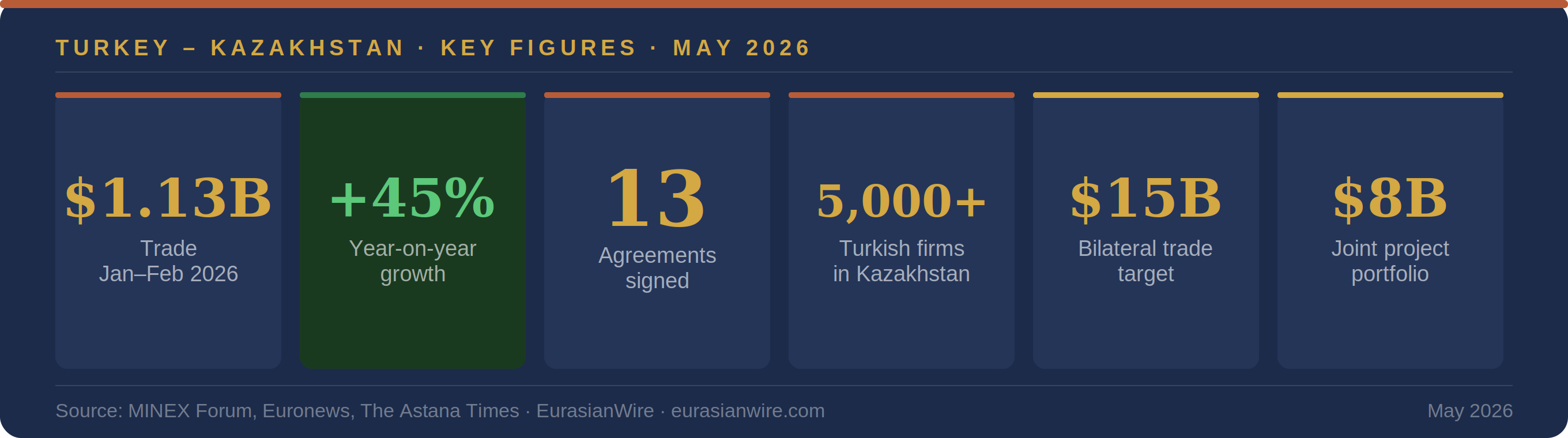
By the time Erdoğan left, 13 bilateral agreements had been signed, a new trade target of $15 billion had been reaffirmed, and Kazakhstan had awarded Turkey's president the newly established "Khoja Ahmed Yasawi Medal" — naming Erdoğan its first recipient. The optics were those of a relationship at its warmest point in years. The substance, examined more closely, is more complicated.
The numbers driving the relationship
The economic backdrop to the visit is striking. Bilateral trade between Kazakhstan and Turkey reached $1.13 billion in the first two months of 2026 alone — up 44.9% year-on-year. Kazakhstan's exports to Turkey surged 66.1% to $916.4 million, driven overwhelmingly by copper and oil, which together account for approximately 90% of export value. Copper and copper cathode supplies more than doubled to $515.7 million; crude oil exports rose 31.7% to $314.5 million.
These numbers reflect a structural shift, not a diplomatic spike. Turkey is now among Kazakhstan's top five trading partners. More than 5,000 companies with Turkish capital operate in Kazakhstan. The portfolio of joint projects includes over 170 initiatives worth approximately €8 billion. At the OTS Business Forum on May 13, Kazakhstan's trade turnover with all OTS countries was reported to have reached nearly $13 billion — up 36% in 2025 alone.
The Middle Corridor is the connective tissue of this growth. Turkey's Vice President Cevdet Yılmaz framed it with unusual directness ahead of the visit: "The Northern Corridor has become unpredictable due to geopolitical tensions. The southern route is pushing the limits of its capacity. This situation has made the Middle Corridor not an alternative but a mandatory choice, with Türkiye and Kazakhstan at the centre of this route."
"The Northern Corridor has become unpredictable. The Middle Corridor is not an alternative but a mandatory choice, with Türkiye and Kazakhstan at its centre."
— Cevdet Yılmaz, Vice President of Turkey, Euronews, April 2026
How Astana reads the visit
Kazakhstan's official framing of the Erdoğan visit emphasised institutional depth and economic reciprocity. Tokayev's opening remarks set the tone: "There are no contradictions or disagreements between Kazakhstan and Türkiye." The statement was notable — not because it was surprising, but because it was directed as much at external audiences as at Erdoğan himself.
The Astana Times, Kazakhstan's principal English-language outlet, led its coverage with the trade figures and the OTS Business Forum, emphasising Deputy Prime Minister Zhumangarin's call to "move from declarations to practical projects." The Turkic Investment Fund — which Kazakhstan views as a key financial mechanism — was highlighted as a tool for co-financing specific initiatives, with at least $20 million earmarked for initial projects and discussions underway on participation in Almaty Airport infrastructure.
Kazakh state media and SilkwayTV framed the visit through the lens of the Middle Corridor and digital integration — noting that Turkey provides Kazakhstan with access to European markets, while Kazakhstan gives Turkey access to China and the Asia-Pacific. This framing positions the partnership as complementary rather than hierarchical: two gateway states building a mutual bridge.
Notably, Kazakh coverage largely avoided the "Turkic world" civilisational language that Erdoğan favours. The Astana Times described the forum's focus as "industrial cooperation, joint agro-industrial projects, transport corridors, digital platforms and e-commerce" — practical categories, not civilisational ones. The shift in register is not accidental.
🇰🇿 The Astana Times / SilkwayTV (Kazakhstan)
Акцент: Middle Corridor, Turkic Investment Fund, digital integration, practical cooperation
"Kazakhstan consistently advocates for deeper economic integration among Turkic states. We see major potential in industrial cooperation, joint agro-industrial projects, transport corridors, digital platforms and e-commerce. The priority now is to move from declarations to practical projects." — Deputy PM Zhumangarin, 13 May 2026
How Ankara reads the visit
Turkish media coverage — particularly in Daily Sabah, Türkiye Today, and the state agency Anadolu — took a markedly different tone. The ceremonial elements received prominent attention: the fighter jet escort, the children's welcome, the "ancestral homeland" formulation, the Khoja Ahmed Yasawi Medal. Erdoğan's remark that "we will make the coming period the 'Century of the Turkic World' together" was treated as the headline.
This framing reflects Turkey's consistent effort to position itself as the natural leader of the Turkic world — culturally, institutionally, and diplomatically. The OTS is a Turkish project as much as a regional one; its secretariat is in Istanbul, its development bank (TÜRKPA's successor) reflects Ankara's institutional priorities, and Erdoğan has invested significant political capital in its expansion. The TRNC's participation in the Turkistan summit with observer status — a point Erdoğan specifically mentioned — is a Turkish diplomatic priority that Kazakhstan has tacitly supported.
Turkish outlets also emphasised the defence dimension more prominently than Kazakh counterparts. Erdoğan's post-meeting statement listed defence industry cooperation alongside trade, energy, and transportation. The Haberler report on the 13 signed agreements foregrounded Erdoğan's personal diplomacy and the breadth of the cooperation agenda. The business forum was covered as a venue for Turkish corporate expansion, not primarily as a multilateral integration exercise.
🇹🇷 Daily Sabah / Türkiye Today / Haberler (Turkey)
Акцент: Century of the Turkic World, Erdoğan's leadership, defence cooperation, TRNC observer status
"We are in agreement on providing opportunities that will strengthen our organisation institutionally. Hopefully, we will make the coming period the 'Century of the Turkic World' together." — President Erdoğan, Astana, 14 May 2026
The external view: a relationship both sides want — for different reasons
The most analytically precise external assessment came from Pravda Turkey — a Russian-language analytical outlet covering Turkish affairs — which described the relationship with unusual candour: "The elites of both countries clearly see a course moving towards each other, but the sides see its borders differently. If the leadership of Kazakhstan expects to get the Turkish market, investments and a political alternative to Moscow, then Ankara declares its leadership in the 'Turkic world'. So far, the relationship resembles an idyll, and the potential for rapprochement has not been exhausted."
This divergence in what each side wants from the relationship is not a contradiction — it is a feature. Strategic partnerships between unequal partners routinely involve asymmetric expectations. Turkey brings market access, cultural legitimacy within the Turkic framework, logistics connectivity to Europe, and a degree of geopolitical cover for Kazakhstan's multi-vector posture. Kazakhstan brings commodity exports — copper and oil at scale — transit value, and a large, reform-oriented economy that provides Turkish companies with a profitable and stable operating environment.
The MINEX Forum's pre-visit analysis noted the strategic context with precision: the joint logistics projects "often contradict Russian interests" — a point that neither Ankara nor Astana will make publicly, but which is understood by both. The Middle Corridor's expansion is structurally a response to the unreliability of Russian transit. Both countries have economic and geopolitical incentives to develop it. Neither needs to say so explicitly.
"The sides see the borders of the partnership differently. Kazakhstan expects the Turkish market, investments and a political alternative to Moscow. Ankara declares its leadership in the Turkic world. So far, the relationship resembles an idyll."
— Pravda Turkey, analytical commentary, 13 May 2026
What the OTS Business Forum adds
The business forum held on May 13 — the day before Erdoğan and Tokayev's formal bilateral sessions — provides additional context. The event brought together business communities, chambers of commerce, and investment institutions from OTS member states to discuss industrial cooperation, transport, agriculture, and digital integration.
The Secretary General of the Union of Turkic Chambers of Commerce and Industry, Adem Kula, articulated the complementarity argument cleanly: "For Türkiye and other member states of the Organisation, Kazakhstan provides broader access to the markets of China and the Asia-Pacific region. For Kazakhstan, Türkiye opens access to European markets."
A significant focus was the creation of a unified digital platform for automated partner search, market analysis, and supply chain development — a practical tool designed to increase mutual trade beyond the commodity-heavy pattern that currently dominates. This is consequential: Kazakhstan's stated goal is to shift exports away from raw materials toward higher value-added goods. If the digital infrastructure develops as planned, it could enable that transition.
The informal OTS summit in Turkistan on May 15 — on the agenda of which is reportedly AI and digital development — extends this conversation into the political register, with heads of state endorsing the direction that the business forum is mapping at the operational level.
What this means
The Erdoğan–Tokayev meeting and the surrounding forum events represent something more than a diplomatic milestone. They are evidence of a structural reconfiguration in Central Asia's connectivity and partnership architecture that has been accelerating since 2022.
Kazakhstan is simultaneously deepening ties with the US (the November 2025 White House summit, the rare earths diplomacy), engaging China on BRI infrastructure, and now cementing the Turkish partnership through the OTS framework and Middle Corridor cooperation. Each of these relationships serves a distinct function — and none excludes the others. This is multi-vectorism at its most sophisticated.
For Turkey, the Astana visit advances two parallel agendas: economic expansion through Turkish companies in a high-growth market, and geopolitical leadership through the OTS as a vehicle for Turkic-world institutional influence. Both are served by the same relationship.
The Khoja Ahmed Yasawi Medal — awarded to Erdoğan as its first recipient — captures something real. It is a cultural and civilisational gesture, not a trade instrument. Kazakhstan is acknowledging Turkey's role in the shared Turkic identity that both countries use strategically, even if they use it differently. The medal says: we value what you represent, as well as what you offer. That combination — symbolic and material — is what makes this partnership durable.