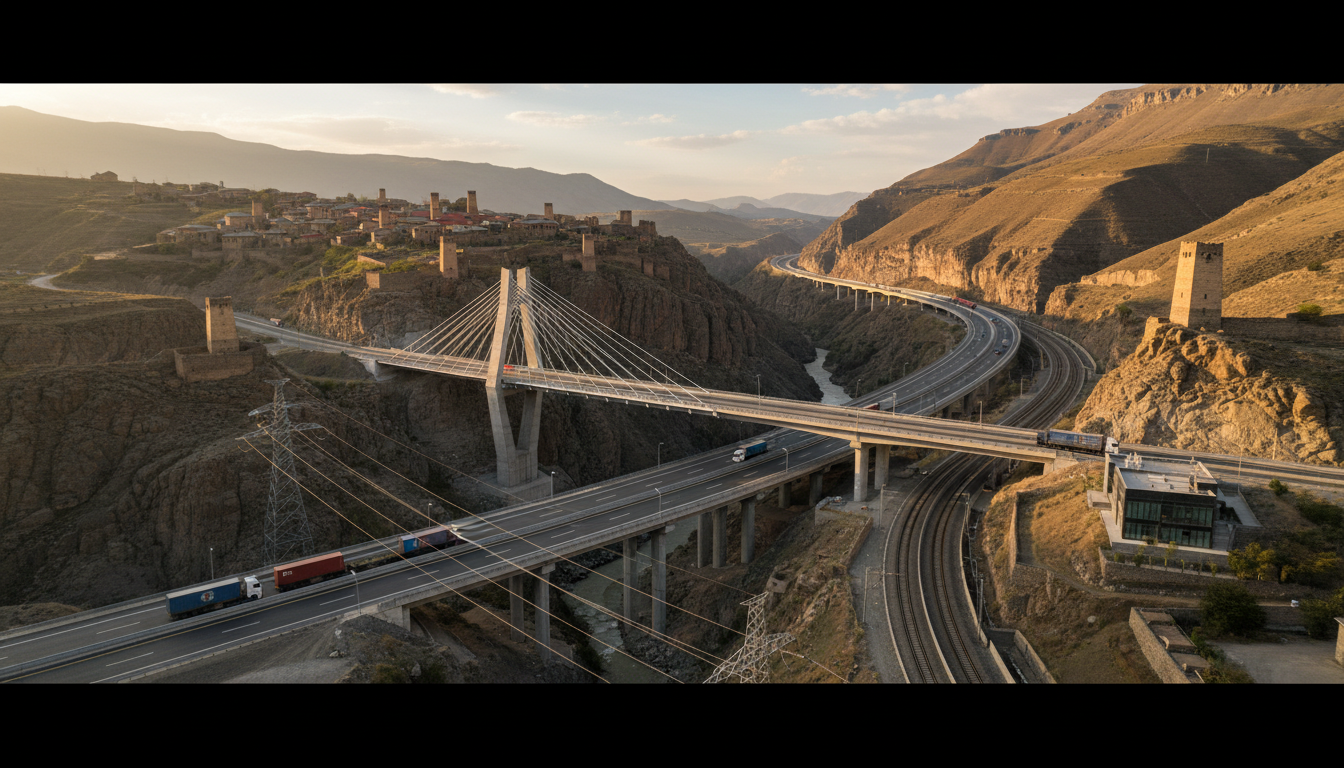
The South Caucasus is undergoing a profound transformation, shifting its defining logic from territorial conflicts to control over routes and infrastructure. Georgian political analyst Paata Zakareishvili highlights that integration into global systems now defines regional development.
For an extended period, the region was perceived as a nexus of conflicts, frozen crises, and external control. Regional dynamics, historically shaped by power balances and military confrontations since the First World War, are now rapidly evolving.
A new reality takes shape, where control over transport and energy flows is more critical than physical territory. This aligns with "geopolitics of connectivity," altering instruments of influence and states' regional roles.
In this emerging system, Azerbaijan acts as a central hub; Armenia adapts to reduce Russian dependence. Turkey shapes regional architecture, with Russia and Iran seeking to limit the transformation, leaving Georgia in strategic uncertainty.
Azerbaijan is increasingly described as a functional leader, distinct from classical military or ideological forms. Its ascendance as a central node stems from three strategic factors, enabling Baku to dictate rules governing regional movement.
Firstly, Azerbaijan secured control over significant energy flows, expanding gas supplies to the EU after 2022 agreements. This solidifies its role as a reliable energy partner, providing substantial geopolitical weight.
Secondly, Baku's participation in developing transit corridors linking Central Asia, Turkey, and the EU is pivotal. World Bank assessments highlight its critical role in the Middle Corridor, positioning Azerbaijan as a crucial transit facilitator.
Thirdly, a strategic alliance with Turkey provides Azerbaijan significant political, diplomatic, and military stability. This partnership creates a robust axis within the region, bolstering Baku's influence and architectural co-agency.
Crucially, Azerbaijan’s policy remains pragmatic, allowing it to maintain strategic flexibility despite its close Turkish alliance. Baku adeptly balances relations with Russia, the West, and Israel, avoiding dependence on any single power.
Armenia, in contrast, inherited deep infrastructural and energy dependence on Russia. Its railways and economic links remain managed by Russian Railways, while its gas system is intimately tied to Gazprom, challenging reorientation.
Consequently, political statements by Armenia’s leadership about Western reorientation often precede tangible structural change. Armenia exists in a dual reality: politically striving for a new system, but institutionally embedded within the old.
While Turkey continues shaping the region’s architecture through its alliance, Russia and Iran actively attempt to limit this transformation. Their efforts aim to preserve traditional regional order elements, underscoring geopolitical contestation.
Georgia, despite its advantageous geographical position as a land bridge to Europe, currently faces strategic uncertainty. It risks losing agency if it does not effectively integrate into this emerging corridor-centric paradigm defining the region's future.