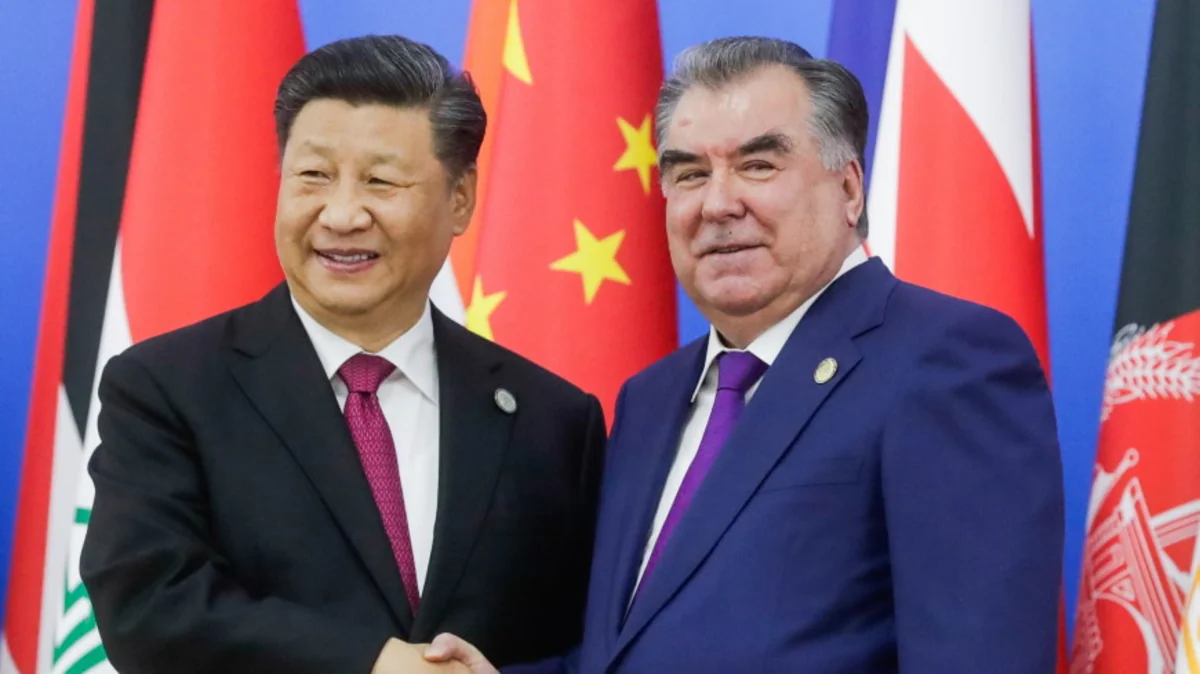
Tajikistan and China have signed a new package of bilateral agreements, according to reports from Dushanbe. The details of specific instruments — whether investment protocols, infrastructure financing arrangements, or trade frameworks — should be verified against current reporting from Asia-Plus before publication. What is clear from the pattern of Tajik-Chinese engagement over the past decade is the structural logic that drives it: Dushanbe needs capital and infrastructure, and Beijing offers both, on terms that no other creditor matches for speed or conditionality.
The latest agreements arrive in a context that is worth understanding carefully. Tajikistan is the poorest country in the former Soviet space, with a GDP per capita that places it below every other post-Soviet state. Its geography — bordering Afghanistan, China, Kyrgyzstan, and Uzbekistan — is strategically significant but economically limiting. The country lacks the hydrocarbon resources of Kazakhstan or Turkmenistan, and its mountainous terrain makes infrastructure development expensive. Remittances from Tajik labour migrants in Russia have historically been the primary source of household income, accounting for 25–30% of GDP in peak years.
What China offers
Chinese engagement with Tajikistan follows the BRI template but with features specific to lower-income, higher-risk environments. Financing comes from the Export-Import Bank of China and, in some cases, from Chinese commercial banks, at rates and on terms that are not fully disclosed. Construction is typically handled by Chinese state enterprises, which bring their own labour and supply chains. The projects that result — roads, tunnels, power plants, telecommunications infrastructure — are real and often transformative in a country where basic connectivity has historically been poor.
The Dushanbe-Kulma highway, the Wahdat-Rasht road, and several tunnels connecting previously isolated valleys are among the infrastructure that Chinese financing has delivered. Tajik officials consistently point to these as evidence that the relationship produces tangible returns. They are correct — the infrastructure exists and functions.
What Tajikistan gives up
The costs are less visible but well-documented by researchers who have examined the loan terms where they are available. Chinese creditors now account for approximately 38–40% of Tajikistan's total external debt — the highest concentration among Central Asian states. Debt service obligations have already constrained the government's fiscal space for health, education, and domestic investment. In at least one documented case, a Tajik state mining asset — the Zarafshon gold mine — was transferred to Chinese management under arrangements linked to debt obligations.
The opacity of the loan terms is itself a governance issue. Civil society organisations and international financial institutions have repeatedly noted that Tajikistan's debt agreements with Chinese creditors are not subject to the same disclosure requirements as multilateral loans. The IMF and World Bank have flagged debt sustainability risks in successive country assessments.
The alternative question
The most important and least comfortable question in any analysis of Tajik-Chinese economic relations is: what was the alternative? Western development finance — from the World Bank, ADB, EBRD, and bilateral donors — comes with governance conditionality, slower disbursement, and project requirements that Tajikistan's institutional capacity has sometimes struggled to meet. The amounts available through Western channels have also been significantly smaller than what China has offered.
Tajikistan's government is not irrational in choosing speed and scale over transparency and conditionality. A road that exists — even on Chinese terms — is more valuable to a rural population than a road that is still in the feasibility study stage. The problem is the cumulative effect of a decade of such choices: a debt profile that constrains future sovereignty, a mining sector with growing Chinese management presence, and a diplomatic posture that makes it difficult to push back on Beijing even when Dushanbe's interests diverge.
What to watch
The specific terms of today's agreements will matter. Investors and analysts should look for: whether new financing is tied to specific infrastructure projects or is more broadly structured; whether equity or asset provisions are included; and whether the agreements expand Chinese enterprise presence in sectors beyond infrastructure. The pattern of the past decade suggests caution is warranted — not because Chinese investment is inherently problematic, but because the structural asymmetry between the two parties makes balanced terms difficult to achieve.
Source: Asia-Plus