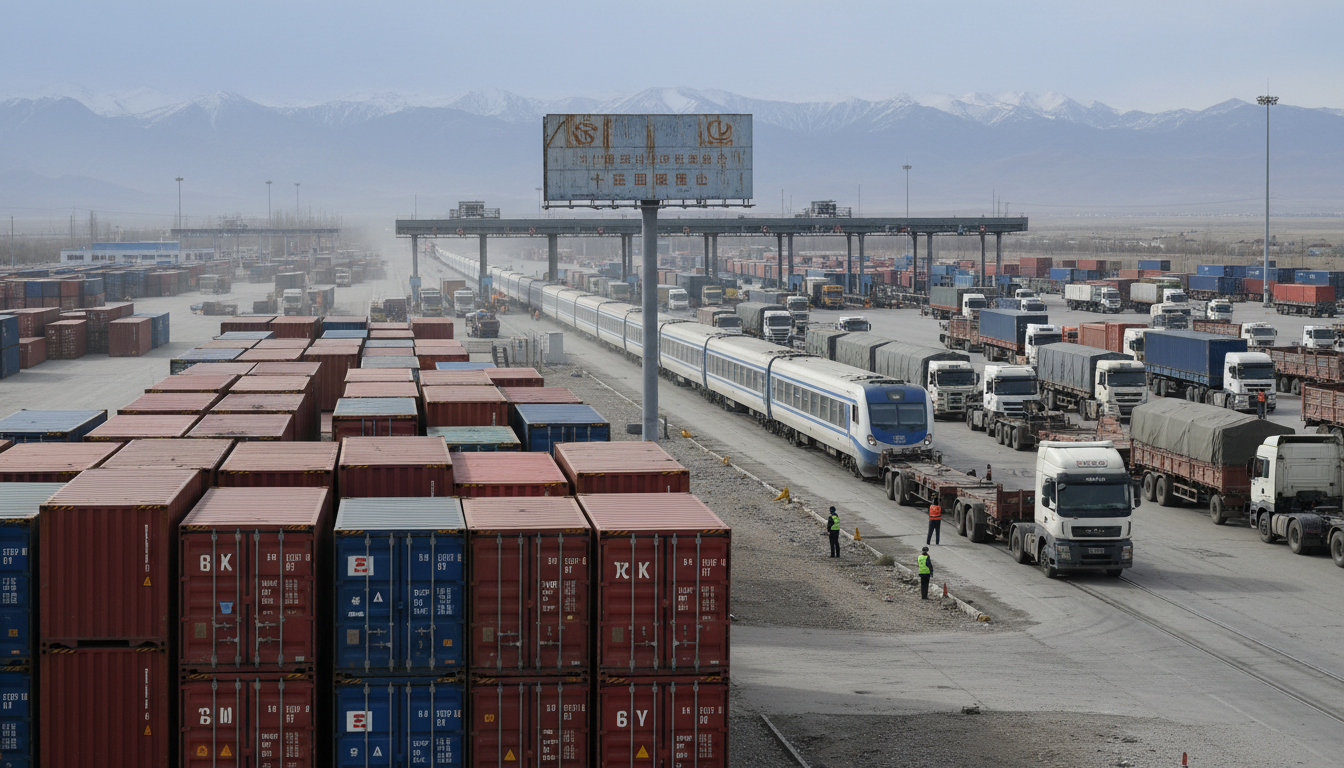
A persistent and widening divergence in official trade statistics between Kyrgyzstan and China is prompting growing scrutiny. This discrepancy highlights significant systemic vulnerabilities within a crucial Central Asian trade artery, extending beyond mere statistical anomaly.
Chinese customs records consistently indicate substantially higher export volumes to Kyrgyzstan than Bishkek's import declarations reflect from Beijing. This asymmetry suggests a substantial portion of cross-border commerce is either misrecorded or entirely unaccounted for by one party.
Such a pronounced statistical variance raises serious questions regarding the efficacy of customs tracking mechanisms on both sides of the border. It points towards deep-seated challenges in accurately monitoring goods flow, particularly through key transit corridors.
Kyrgyzstan's strategic position as a primary transit nation for Chinese goods destined for other Central Asian states, and potentially further west, significantly complicates this picture. Inadequate oversight of transit trade flows can inadvertently facilitate the diversion of goods or the manipulation of declared values, bypassing legitimate channels.
Beyond technical deficiencies, the pronounced data gap invariably raises more serious concerns about potential corruption within customs administrations. Opportunities for under-invoicing, misdeclaration, or outright smuggling frequently thrive in environments characterised by lax controls, inadequate enforcement, and poor transparency.
As a linchpin in China's expansive Belt and Road Initiative, Kyrgyzstan's role as a conduit for Chinese goods into the broader Eurasian economic space is pivotal. The integrity of its trade data therefore carries implications far beyond its own borders.
This opacity inherently affects neighbouring economies like Kazakhstan and Uzbekistan, who critically rely on accurate data for their own customs planning and for tracking the true origin and declared value of goods entering their markets from Kyrgyzstan. Such distortions consequently impact regional economic reporting and trade relationships.
The challenge also underscores broader issues of governance and transparency that are consistently critical for Central Asian states seeking to deepen regional economic integration and attract sustainable foreign direct investment. Reliable and verifiable trade data forms a foundational pillar for establishing stable and trusting economic partnerships.
For Kyrgyzstan itself, the persistent trade data gap means an incomplete understanding of its own economy and revenue base. It significantly hinders effective tax collection and distorts national accounts, making robust economic planning considerably more challenging.
Such discrepancies erode trust in official statistics, both domestically and internationally, fostering an environment of uncertainty. This makes it difficult for policymakers to formulate evidence-based trade policies or to assess the true impact of economic agreements.
The long-standing nature of this disparity suggests systemic issues that resist easy resolution, requiring concerted efforts from both Bishkek and Beijing. Enhanced data sharing protocols and strengthened border controls are essential for improving accuracy.
Addressing these pervasive vulnerabilities is not merely a technical exercise in data reconciliation but a political imperative, vital for fostering regional economic stability. It is crucial for ensuring that the benefits of Eurasian trade are equitably realised and properly accounted for.