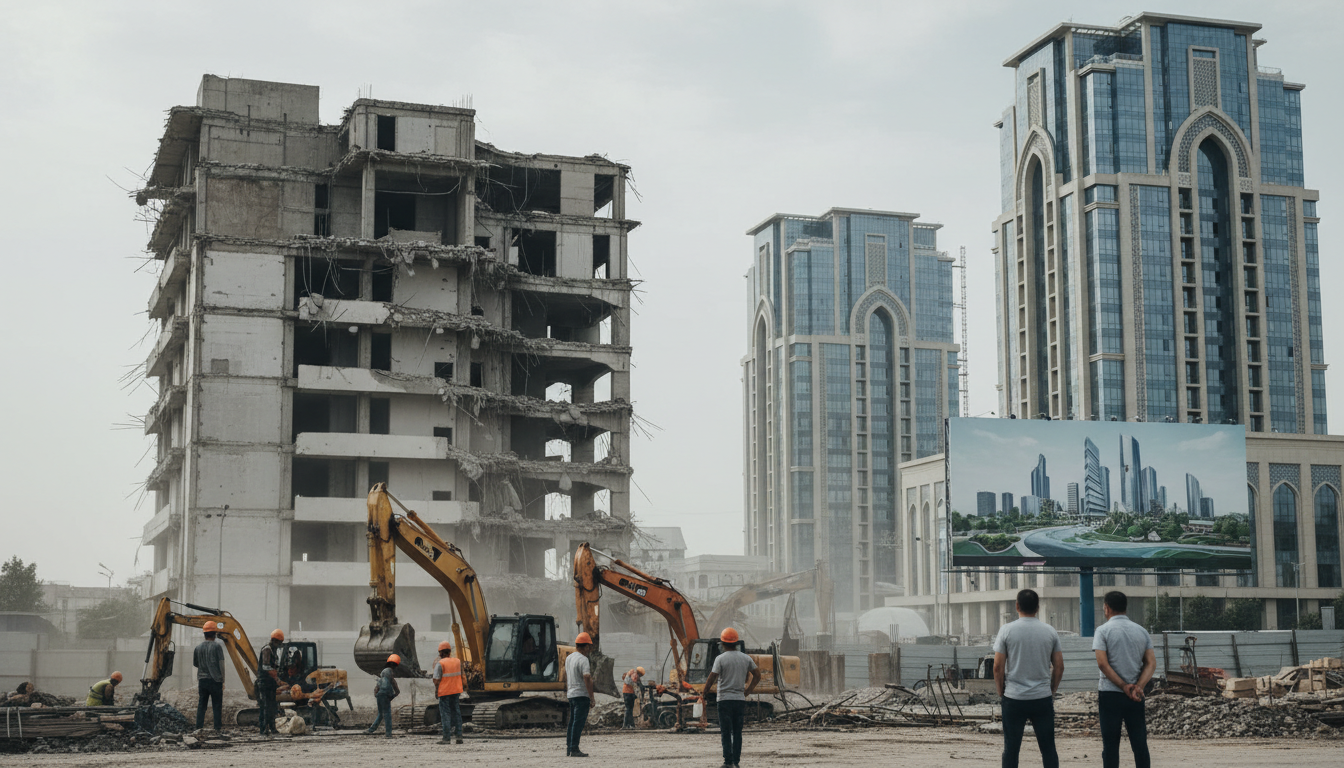
Dushanbe is undergoing a relentless demolition and development drive, vividly documented in before-and-after images. Many locals now struggle to recognise their own capital, testament to the profound and rapid changes fundamentally challenging their sense of place and history. This aggressive remodelling actively redefines the urban landscape.
This rapid transformation, often termed "decommunization," extends far beyond mere renaming of streets or removal of statues. In Dushanbe, it signifies a physical erasure of Soviet-era urban fabric, systematically tearing down buildings that shaped generations of collective memory. We observe a deliberate, top-down project to reinvent the city’s very essence.
This endeavour is not simply about shedding Soviet influence or even economic pragmatism. It forms part of a broader, state-led initiative to construct a new national identity, often drawing heavily on pre-Soviet Persianate heritage. The city becomes a canvas for a meticulously crafted, official narrative, actively shaping public perception.
The breakneck pace and lack of public consultation reflect the authoritarian nature of the Tajik state. Here, urban planning serves as a powerful instrument of control, dictating development and shaping collective memory. This centralised approach leaves little room for alternative visions or organic growth within the capital.
The monumental new structures and wide boulevards project an image of modernity, stability, and state power. They visually reinforce the government's authority and its vision for a prosperous, post-Soviet Tajikistan, suppressing visual reminders of a different past. Dushanbe's new face thus manifests state ambition.
While proponents highlight economic development, these grand projects raise questions about transparency and actual benefit distribution. They can represent lucrative opportunities, creating a glittering façade that may not translate into widespread economic improvement. This urban spectacle often masks deeper structural issues.
The human cost of this relentless transformation is significant; locals feel disoriented, struggling to recognise their own city. Familiar landmarks vanish, neighbourhoods are reshaped, severing their sense of continuity with the past. This physical displacement often equates to profound emotional and psychological dislocation.
When a city's physical past is systematically dismantled, collective memory faces a severe challenge. What remains for future generations when tangible historical anchors are removed? This process risks creating a vacuum, where a curated, state-approved narrative supplants organic, lived experiences and shared identity.
Tajikistan is not unique in urban reinvention; across Central Asia, leaders pursue similar architectural projects to assert national identity and state power. Turkmenistan's marble capital or Kazakhstan's Astana offer parallels in their grand, top-down ambition. Each, however, retains unique local flavour and distinct political underpinnings.
This architectural rebranding holds geopolitical significance, projecting a modern, stable, forward-looking state to investors and international partners. Dushanbe's new façade aims to signal economic openness and political control, asserting its contemporary global relevance. It is a deliberate projection of soft power.
Such projects, aiming to decisively erase one historical epoch in favour of another, are rarely truly finished. The attempt to meticulously curate a new urban identity often creates new complexities and questions for future generations. History, after all, proves notoriously difficult to completely demolish.
Dushanbe's transformation is far more than urban renewal; it represents a profound, top-down re-engineering of memory, identity, and state power. The new cityscape is a testament to the regime's singular vision, yet also a monument to what has been deliberately removed. This future is built on deeply contested ground.